
TL: DR
- Generative AI has prompted widespread contemplation about its potential impact across various industries.
- Large Language Models (LLMs) enable the understanding and automation of unstructured data for the first time.
- According to our research, there is a staggering $2.45 trillion automation opportunity across all industries, highlighting the immense potential of this technological shift.
- Automation of unstructured data and communication has already demonstrated immense value, and this trend is expected to persist, bringing substantial benefits for both SaaS vendors and customers.
- Understanding the mix of unstructured and structured data a business process relies on helps predict whether an incumbent or new entrant will win a category. Incumbents will continue to lead categories enabled by structured data processes. In this instance, incumbents will offer features to automate the unstructured component of the business process. We expect new AI-native entrants to lead in categories primarily enabled by unstructured data.
Automating Unstructured Data Workflows for the First Time
Traditionally, enterprise software has automated business processes reliant on structured data. This data type is meticulously organized into formatted repositories, such as databases, making it easy to access and analyze. Examples like Salesforce, Workday, and ServiceNow illustrate how software can drive workflows based on structured data. The automation of structured data is now a $145 billion industry.
There has always been another side to the data spectrum predominantly handled by humans: unstructured data and communication. Unlike its structured counterpart, unstructured data is often text-heavy, lacking a specific and predictable format. It includes email communications, customer feedback and reviews, documents, contracts, and call center transcripts. While rich in insights, such information has been elusive to software thus far.
The dawn of Large Language Models (LLMs) has ushered in a new era, enabling us to understand and automate unstructured data. The limitations that once bound the SaaS industry are dissipating, and the capabilities to explore, comprehend, and harness both structured and unstructured data are becoming an achievable reality.
A Present-Day Revolution: The Impact of Generative AI on Business
The innovations driven by software built on top of LLMs have tangible impacts on business operations. Let’s explore customer success, content generation, and coding examples.
Customer Success:
Then: In 2011, Zendesk revolutionized the customer support landscape by automating the customer service ticketing process, saving their enterprise clients millions. However, the solution was only partially autonomous, requiring human intervention to resolve those tickets. With 100K customers across a range of industries, the ROI this provided was immense, highlighting the capacity of traditional enterprise software to automate the structured portion of customer service.
Now: LLMs make it possible to automate the complete workflow of customer service, resolving 30 to 50% of tickets through automated chat and dramatically reducing the need for human labor. The improvements are staggering, with over 50% ROI predicted, indicating a profound shift in customer service operations.
Content Generation:
Then: The cost of content generation was substantial, with freelance writers charging approximately $600 per 1000 words.
Now: LLMs have drastically reduced the cost to mere cents for generating 1000 words. With just 20% of a writer’s time required for editing, this represents savings of ~$480 per piece, enabling businesses to scale content creation at a fraction of the previous cost.

Coding:
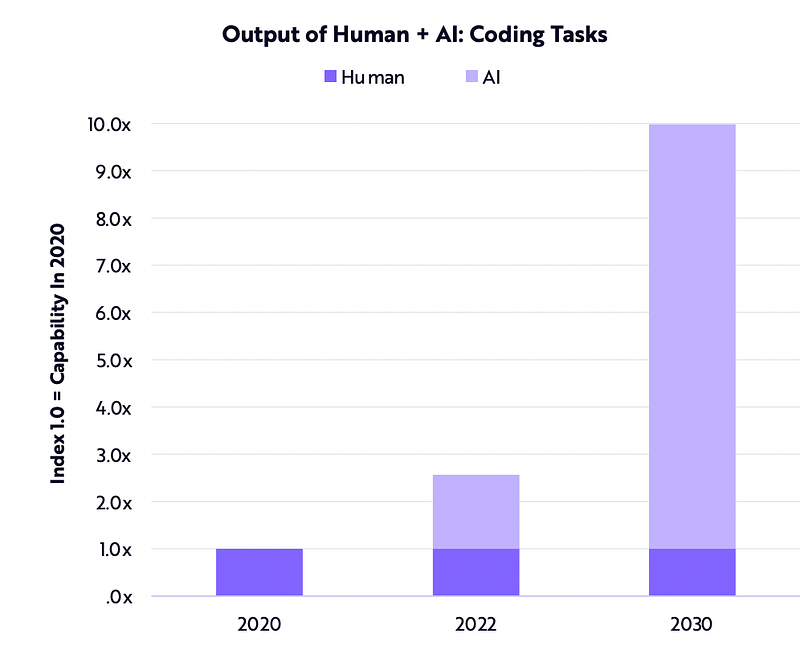
The adoption of off-the-shelf coders augmentation solutions like GitHub Copilot, CodeWhisperer, and Codey amplifies the impact of LLMs on coding. With a relatively small investment in training, these tools have already increased engineers’ efficiency by 2.5x, accelerating development timelines. The implications for project efficiency are significant, allowing for more rapid innovation and potentially transforming the entire software development cycle. According to BCG, such efficiency gains could account for 10% of the IT cost baseline, affecting up to 65% of overall IT costs and translating into hundreds of millions of dollars in savings for Fortune 500 companies.
Capturing the Opportunity: Predictions for the Future of Enterprise Software
This is a $2.45 trillion opportunity annually, signaling a revolutionary change that promises to reshape the very fabric of how industries operate and thrive. Our methodology builds on Goldman Sachs’ Report, which reviewed the share of industry employment exposed to Automation by AI. We then augmented the chart with annual wage data from the Bureau of Labor Statistics to comprehend the value of those specific portions within each industry.

While the opportunity is vast, capturing it requires a nuanced understanding of how business processes intersect with structured and unstructured data. Here’s how we foresee the landscape evolving:
Structured Data > Unstructured Data:
We see two outcomes for enterprise software businesses primarily reliant on structured data.
- Established enterprise software companies will continue as leaders, leveraging LLMs to enrich their offerings with unstructured workflow automation. This benefits customers with simplicity and opens new revenue streams. Notable examples are Intercom AI’s resolution bot ($0.99 per resolution), Github’s Copilot ($19 per user per month), and Shopify’s ‘Magic.’
- Emerging entrants will offer comprehensive product suites, automating structured and unstructured processes. These are already growing in industries like construction, which relies on structured and unstructured data but needs a clear software leader. Being early in their journey, these companies will utilize LLMs swiftly to find product-market fit, an approach akin to Seth Rosenberg from Greylock’s insights. One notable example from our portfolio is Incentivio, a fully automated intelligence-driven guest engagement platform for restaurants and virtual kitchens.
Structured Data < Unstructured Data
For sectors mainly reliant on unstructured data, where traditional software players cannot serve, new AI-native entrants will forge the path. These verticals have been restrained by the limitations of existing technology, with at least 55% of data needing to be easier to analyze. Solutions like Collective’s bookkeeping and accounting for solo entrepreneurs are spearheading this automation.
Despite the clear ROI, the road to widespread enterprise adoption is complex. The pace of change might be moderated by factors such as privacy and accuracy concerns, governance challenges, a widespread lack of generative AI and machine learning expertise, and many projects are based on enhancing products rather than where the core value resides — utilizing Gen AI in the business unit.
At Ardent, we recognize that the key to navigating this transformation lies in understanding how each enterprise interacts with structured and unstructured data. In our next post, we’ll identify which industries and sectors stand to benefit most from generative AI.