In September, OpenAI's GPT-6 Astra took control of two robot arms without being trained for them. In an open evaluation by Robocurve, an independent evaluator, it put a block in a bowl 19 times out of 20, where another frontier model managed 8. It fit a puzzle piece into its slot only twice in 20 tries, no better than that other model.¹
The gap is contact. A frontier model can reason about where the piece should go. It cannot predict whether the piece will jam when pushed, or how hard to push. Predicting what happens at the moment of contact, before committing to it, is the job a world model does, and a language model does not.
Robotics learned this before anyone else. It could not afford to learn only by acting, so it built models of consequences first. That makes the physical world the place where world models can be seen working. It is also where you can see the value moving: away from the model, and toward the deployment data that corrects it.
Our first post defined a world model as one that can answer the question "what happens if." This post takes that test into the physical world, the most developed category, and asks a narrower question: which of these models can a robot actually use?
Why robots built world models first
A robot reaching for a cup next to a block tower can learn by knocking the tower over. It learns slowly that way, one fallen tower at a time. When the tower is a person, or the cup is hot, the error is not a lesson. It is a harm.
Three properties of the physical world make a world model a requirement rather than a choice.
Every action leaves a record. A robot's sensors capture what it did and what happened next. The training data a world model needs builds up as the robot works.
Feedback arrives too late. The robot learns that the cup slipped only when the cup hits the floor. That is fine when the cup is empty. It is not fine when the cup is hot. In those cases, the model must provide feedback before the action is taken.
The world keeps changing. Objects shift, people walk through, lighting and surfaces change. The robot has to predict what a move it has never made will do in a scene it has never quite seen.
What a physical world model is
Our first post on world models set out a four-part test. A world model represents the state of the world, accepts an action, predicts the next state, and continues simulating from its prediction. Let's walk the robot reaching for the cup through each part.
The world is physics: matter, motion, and contact. The cup has a weight, the table has friction, and the robot's hand has a grip.
The hard part is the state. Some of it a camera can see: where the cup is, or how fast the hand is moving. Some of it a camera cannot see: how heavy the cup is, whether it is full, whether the fingers have touched it yet, or how firmly they are holding it. Whether the cup rises or slips depends on both. A model that carries only the visual picture is missing half the state.
The action is what the robot does next: close the fingers and lift the arm two inches. The prediction is the next state. If the robot closes its fingers with a certain pressure and lifts, then the model predicts one of three outcomes: the cup rises with the hand, stays on the table while the fingers slide, or tips. The prediction can be output as video, a 3D scene, or an internal representation.
Then, the model keeps going. It takes its own prediction as the new state, applies the next action, and predicts again: the cup rises, the arm swings toward the tower, the cup clears the tower or clips it. That is the rollout. It lets the robot run a whole plan in its head before moving. If the plan ends with the tower on the floor, the robot picks a different one.
A world model is used for two things. The first is checking. Before a new control policy is deployed on a robot, it is tested in the world model across thousands of simulated scenarios, so its failures show up in the model rather than on the floor. Wayve uses its world model to evaluate its driving AI before it ships.²
The second is practice. The policy learns inside the world model's predictions rather than on the real robot, which is slow and can break things. DayDreamer, a 2022 result from Berkeley, taught a four-legged robot to walk with about an hour of real-world time, because most of the learning happened inside the model.³
One real demonstration becomes many imagined ones. That is what changes the economics of robotics.
Which world models a robot can use
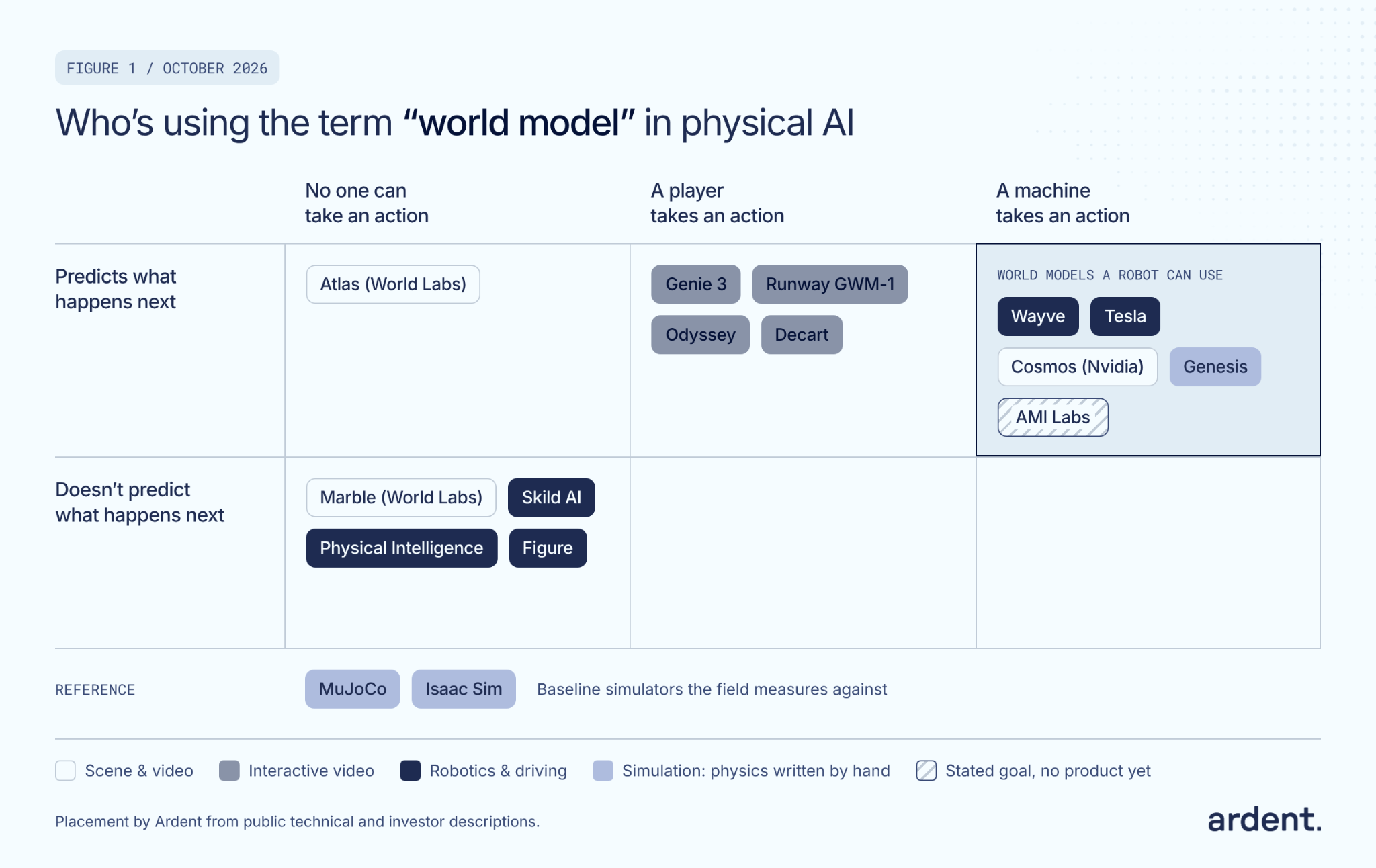
Figure 1. Who's using the term "world model" in physical AI, October 2026. Placement by Ardent from public technical and investor descriptions. Read the map two ways. Across: who can take an action in the model (no one, a player, or a machine). Down: whether it predicts what happens next.
It is early, and the term “world model” is being applied to almost anything that models the physical world.
Taking a machine's action is not part of our first post’s definition. It is a usability test on top of it. A model can pass the definition and still be one a robot cannot use. The top-right corner contains the only models a robot can use: those that predict what happens next when a machine takes an action.
Policies sit bottom left. A policy takes in what the robot sees and returns what the robot should do. It predicts the next action, not the next state. The models inside Skild AI, Physical Intelligence, and Figure work this way. A policy is what a world model trains and checks, and the best ones are the most important models in robotics today. However, they are not world models. The most general policy yet is a frontier language model driving a robot directly, which is where this post started, and contact is where it breaks.
Scene builders sit there too. World Labs' Marble turns photos or text into a 3D world you can walk through, and it does the first part, the state, well. But walking through it does not change it. The view changes, and the world does not: the cup stays where it is; nothing falls.
Video models predict, but no one can take an action in them. World Labs' Atlas can show a plausible future, frame after frame, and you can set the path of its camera.⁴ But moving the camera is not acting in the world. Atlas cannot answer what happens if the robot does something else, because there is no way to tell it.
Interactive video models take a player's action. Genie 3, Runway's GWM-1, Odyssey, and Decart take a controller input and show the resulting output. They pass the four-part test. But a player's actions are move, turn, and jump. They carry no grip or force, so these models cannot answer the question a robot asks at the moment of contact.
The corner holds models that take a machine's action. Wayve sits here, and so does Tesla by its own description, both trained on what real cars did and what happened next. Nvidia’s Cosmos sits here as well: its open world model takes robot and vehicle actions as input and predicts what happens next.⁵
Simulators belong in this story as well. MuJoCo, Isaac Sim, and Genesis's simulator carry the state, take the action, predict the next state, and roll forward. Their physics was written down by people rather than learned from data, so each is a world model exactly as good as its written physics. The open question for every simulator is how far its world differs from the real one. MuJoCo and Isaac Sim are the baseline the field measures against, so they sit in the reference strip while Genesis sits in the corner.
AMI Labs is striped: it has the goal and not yet the model. Its stated goal is exactly this corner: an action-conditioned model that predicts in an internal representation, allowing a robot to plan. It raised $1.03 billion in March and has not yet shipped a product.⁶ Emulate, founded in August by researchers behind DeepMind's Genie models and reported in talks for a seed of up to $700 million, has also not released anything just yet.⁷ The difference is that AMI's architecture is public (it builds on JEPA, the approach LeCun developed at Meta) and Emulate has yet to publish anything, so Emulate stays off the map until it does.
Where the data comes from
A world model is trained on records of the world changing: the state, the action taken in it, and the resulting state. Where that record comes from is the whole question in the physical lane, because the physical world does not log itself.
The robot's own operation is the complete record. Its cameras and joint sensors give the state, its motor commands give the action, and the next sensor reading gives the outcome. Teleoperation produces this record before a product exists, with a person driving the robot. Deployment produces it afterward, at the customer's site. It is the most expensive data per hour, and the only kind that contains the environment the robot will work in. Driving fleets are the same record at scale: Wayve and Tesla train on camera footage paired with the steering and throttle the car applied.
Simulation generates the record from written physics, at almost no cost. It cannot generate the gap between its physics and the real world. Genesis AI attacks that gap directly, pairing its in-house physics simulation with real robot data collection in a closed loop.⁸ Simulation fits environments whose geometry is known.
Human video supplies the state and what followed, but no robot action. Internet video of people doing things is the largest record of the physical world, though it contains no motor commands. Converting it means inferring the action from the person's hands and body. It fits open-world tasks where no simulator has the geometry. Skild, for one, trains its model on human video alongside simulation and teleoperation.⁹ Game footage with controller inputs (General Intuition, Worldmodeldata) is the easy case of the same idea, since the action is already logged.
Contact and force are the channels none of these capture well. A camera does not see how hard the gripper is squeezing. Most commercial data gloves capture hand pose rather than force, and the gloves that do measure force are still mostly research hardware. Contact and force are the most expensive channels to fill and have the least data. They are also what GPT-6 Astra was missing.
The moat is the loop
Deployment is where the record becomes a moat. Every robot in a customer environment generates data about that environment's geometries, failure modes, and unwritten rules. That data is local, operational, and cannot be synthesized.
World models and deployment data compound each other rather than compete. The model lowers the cost of getting to deployment through practice and checking. Deployment then supplies what the model is worst at: the rare contact events, the tails of the failure distribution that nominal data never contains, and the places where a policy has learned to exploit the model's mistakes.
Not every company gets this loop. It needs a record of state, action, and outcome from every deployment, and a world model of the company's own trained on it. A company that rents its model and fine-tunes it on deployments still improves, but the improvement lives in a model it does not own.
Whose model gets better depends on the contract with the model provider.
Meanwhile, teaching a robot a new task is getting cheaper. Skild says its S1 model can carry out an unseen task of up to ten minutes from a single video of a person performing it, and estimates that one video does the work of about 380 teleoperated demonstrations. In the same study, though, a model post-trained on 2,000 demonstrations still outperformed the single video.⁹ So the moat is not the ability to teach a robot a new task since that cost is falling fast. The moat is closing the last stretch of reliability in a specific environment and proving it, and this comes from deployment, not the simulator.
Where the money went, and where it goes next
On September 28, 2026, AMD agreed to buy World Labs, Fei-Fei Li's company, for $8.2 billion in stock, seven months after World Labs raised $1 billion.¹⁰ It is set to be the category's first significant exit.
Nearly all of the capital so far has gone to one tier: the companies building a foundation-scale world model, and the video companies closest to them. AMI Labs raised $1.03 billion in March. Runway, Odyssey, Decart, and General Intuition each raised rounds of $300 million or more, and General Intuition added another $220 million in September. Emulate is reportedly in talks for a seed round of up to $700 million, and Veeda, founded by former Nvidia world-model researchers, raised a $90 million seed round in August.¹¹ Add the robot foundation-model companies that use world models as components, with Skild's $1.4 billion round in January and Physical Intelligence's $600 million round last November, and the picture is clear.¹² The money went to the top of the stack, and the AMD deal priced what that tier is worth to a platform owner.
The AMD deal also says where that tier ends up. The buyer is a chip vendor, not an application company. Nvidia, also a World Labs investor, is building Cosmos as a competing open world model. Li said the next generation of AI needs close collaboration across model research, systems, and compute. Neither company has said what the deal means for Marble and Atlas.¹³ A frontier physical world model becomes part of a platform owner's stack. The value above it goes to whoever owns the data the platform does not have, and to the products built on top.
That splits the opportunity in two.
Growth-stage capital goes to companies that already have a model and a fleet. The question there is whether deployment data compounds the way the last section describes: Wayve and Tesla in driving, 1X in humanoids, and the robot foundation-model companies as they move from forgiving tasks into contact-rich ones. The bet is on the loop closing: a company that records state, action, and outcome at scale, trains on it, and shows reliability rising in specific environments as a result.
Seed capital goes underneath, to companies that own what the platforms lack: data conversion (video to robot signal, game engine to action-state pairs, capture to contact and force), evaluation and practice environments sold to the hardware tier, and physics-lab founders whose architectures may carry over into other worlds. One of those is kausable, from physicists with ties to Black Forest Labs. Aether AI, which builds causal structure learning into a physical world model, is another. The first evidence the slot is being funded came last October, when Moonlake raised $28 million. This summer brought more announcements: Aether AI ($20 million), kausable (€12 million), and Worldmodeldata (£7 million, a round that closed the previous December).¹⁴
What the physical world teaches the others
The physical world is where world models can be seen working, and it got there first because it had no choice. Three lessons carry to the other worlds.
- Build the record. A world model is trained on actions paired with consequences, and the physical world has that record because robots cannot act without producing it.
- Predict before you act. The model earns its place when feedback is slow, or the error is costly.
- The moat is the loop, not the model. Foundation world models are becoming platform infrastructure, and the durable value is in the deployment data that corrects them.
The next two posts take on the other worlds. The economic world has the record problem: companies log what happened, not the decisions that caused it. The digital world is acquiring the robot's problem, as long-running agents start doing things that cannot be undone.
The physical world built world models because it could not afford to act without them. The question for every other world is what it has been doing instead and for how much longer it can do so.
Companies and researchers mentioned
Companies
- World model builders: AMI Labs, Decart, Emulate, General Intuition, Genie 3 (Google DeepMind), Odyssey, Runway (GWM-1), Veeda, World Labs (Marble, Atlas)
- Machine-action world models: Nvidia (Cosmos), Tesla, Wayve
- Simulators: Genesis AI, Isaac Sim (Nvidia), MuJoCo
- Robot foundation models and policies: 1X, Figure, Physical Intelligence, Skild AI
- Data, evaluation, and physics-lab layer: Aether AI, kausable, Moonlake, Robocurve, Worldmodeldata
- Frontier labs and platforms: AMD, Anthropic, Black Forest Labs, OpenAI
Researchers
- Pieter Abbeel, Alejandro Escontrela, Ken Goldberg, Danijar Hafner, Philipp Wu (DayDreamer, Berkeley)
- Ashok Elluswamy (Tesla)
- Sanja Fidler (Veeda)
- Yann LeCun (AMI Labs)
- Fei-Fei Li (World Labs)
Notes
- Robocurve, GPT-6 Astra evaluation results, September 4, 2026 (openai.robocurve.org), and Claude Fable 5.1 evaluation results, September 3, 2026 (anthropic.robocurve.org); 20 trials per task on dual I2RT YAM arms. See also Humanoids Daily, "OpenAI's GPT-6 Astra Hits 95% on Physical Manipulation Benchmark, But Precision Tasks Expose Familiar Bottlenecks," September 2026. humanoidsdaily.com
- Automotive World, "Wayve unveils GAIA-3 for autonomous driving tests," December 2025. automotiveworld.com
- Philipp Wu, Alejandro Escontrela, Danijar Hafner, Ken Goldberg, and Pieter Abbeel, "DayDreamer: World Models for Physical Robot Learning," Conference on Robot Learning, 2022. arxiv.org/abs/2206.14176
- World Labs, "Atlas: A World Model for Spatial Intelligence," September 1, 2026. worldlabs.ai
- Humanoids Daily, "Tesla AI Chief Details Unified 'World Simulator' for FSD and Optimus," on Ashok Elluswamy's talk at ICCV 2025. humanoidsdaily.com; NVIDIA, Cosmos 3 model card, on action-conditioned generation for supported robot and vehicle embodiments (huggingface.co).
- TechCrunch, "Yann LeCun's AMI Labs raises $1.03B to build world models," March 9, 2026 (techcrunch.com); SiliconANGLE, "Yann LeCun's new startup AMI Labs raises $1.03B to train world models," March 10, 2026, on its JEPA roots (siliconangle.com).
- The Next Web, "Former DeepMind world-model researchers' startup Emulate in talks to raise $700M," September 2026. thenextweb.com
- Genesis AI, "Genesis AI Emerges From Stealth with $105M to Build Universal Robotics Foundation Model and Horizontal Platform for General-Purpose Physical AI," press release, July 1, 2025. aap.com.au
- Skild AI, "Introducing S1: In-Context Learning for Robotics," August 2026 (skild.ai); NVIDIA, "Skild AI Taps NVIDIA Physical AI to Teach Robots New Tasks From a Single Video" (blogs.nvidia.com).
- AMD, "AMD to Acquire World Labs to Advance the Future of AI Compute," September 28, 2026 (ir.amd.com); World Labs, "World Labs Announces New Funding," February 18, 2026 (worldlabs.ai).
- SiliconANGLE, "World model startup Runway closes $315M funding round," February 10, 2026 (siliconangle.com); TechCrunch, "World model maker Odyssey nabs $1.45B valuation backed by Amazon and other big names," June 17, 2026, on Odyssey's $310 million Series B (techcrunch.com); Globes, "Decart raises $300m including Nvidia investment," May 18, 2026, citing The Wall Street Journal (en.globes.co.il); "General Intuition is turning video game clips into AI training data for robots," June 25, 2026, on General Intuition's $320 million Series A (finance.yahoo.com); SiliconANGLE, "World model startup General Intuition closes $220M investment," September 29, 2026 (siliconangle.com); SiliconANGLE, "Sanja Fidler's world model startup Veeda AI raises $90M in seed funding," August 19, 2026 (siliconangle.com). Emulate: see note 7.
- Bloomberg, "Robotics Startup Skild AI Valued Above $14 Billion in New Round," January 14, 2026 (bloomberg.com); Bloomberg, "Robotics Startup Physical Intelligence Valued at $5.6 Billion in New Funding," November 20, 2025 (bloomberg.com).
- AMD press release (note 10), source of Li's quote; it says the World Labs team will continue to focus on AI model research and does not address Marble or Atlas as products. On Nvidia as a World Labs investor: SiliconANGLE, "World Labs closes $1B investment backed by Nvidia, AMD and Autodesk," February 18, 2026. siliconangle.com
- Enterprise AI World, "Moonlake AI Emerges from Stealth with $28M Seed," October 2025 (enterpriseaiworld.com); The Next Web, "Aether AI lands $20mn for causal AI," June 2026 (thenextweb.com); HTGF, "European AI startup kausable raises €12 million in Seed Round," July 23, 2026 (htgf.de); Tech.eu, "Worldmodeldata lands £7M to turn gaming data into AI training," July 6, 2026 (tech.eu); The Next Web, on the Worldmodeldata round closing in December 2025 (thenextweb.com).